
Trusted by 1000'S of software developers and industry leaders alike





















How Software Escrow Works
Automated Software Escrow
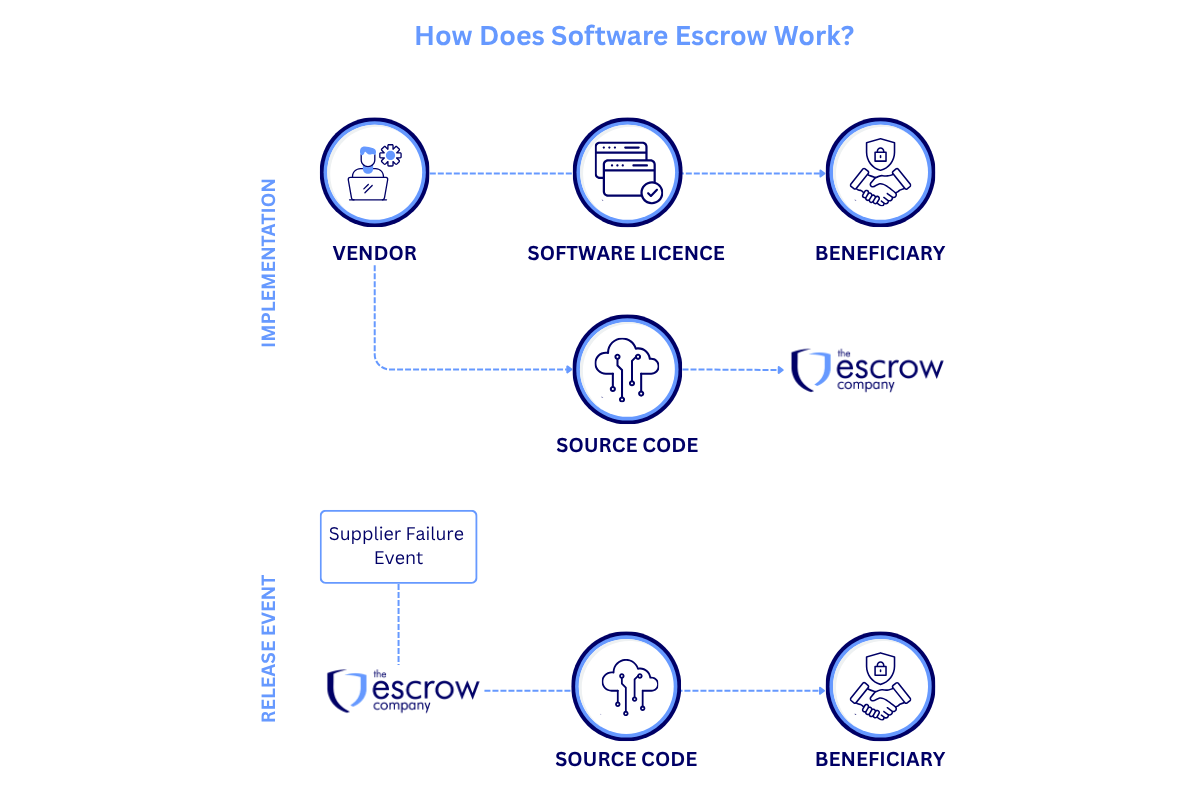
Software escrow or Information escrow is a three party agreement between a vendor (the depositor), the end user (beneficiary) and the software escrow agent (The Escrow Company). The objective of a software escrow agreement is to provide assurances to the beneficiary, that if the software vendor or IP owner is unable or unwilling to support the software, the source code and other critical materials such as documentation can be released to them for continuity purposes.
During the agreement setup, the software vendor will deposit the latest version of the source code with The Escrow Company. This is typically through our automated deposit system directly from GitHub, Bitbucket, GitLab and many other popular version control apps or via SFTP or S3 buckets.
This software escrow deposits would only be released to the beneficiary party, under certain pre agreed conditions such as if the depositor can no longer support or maintain the software. The requirements for deposit and release of the source code are all clearly defined and negotiated upon in the source code escrow agreement.
Beneficiary Benefits
Software Escrow Benefits

Improving Operational Resilience
Ensure that you have access to the necessary resources, materials and knowledge to continue to manage or maintain critical software in the event that something happens to the software vendor.
Internal governance and standards
Enhance resilience across your software supply chain by applying a widely adopted framework that proactively addresses supplier risk.
Cloud migrations (On-prem to SaaS)
Transitioning from a legacy or on-premise system to a hosted model places greater reliance on your supplier to ensure cloud availability, data integrity, and software performance, ultimately elevating your risk exposure.
Meet Industry Standards
In regulated markets, having stressed exit and tested recovery plans is essential to comply with industry guidelines and protocols.
Avoid Costly Disputes
In the event of a dispute with your software vendor, having the source code or other IP in escrow can help you avoid costly legal proceedings and ensure continued access to the solution.
Build Supplier Relationships That Last
Software escrow allows vendors to reassure potential clients that they take business continuity seriously, building trust and confidence, especially in new partnerships.
Our Software Escrow Services
Agreement Types
Single Beneficiary Source Code Escrow Agreement
A single beneficiary software escrow agreement is used when a client is licensing software from a software vendor but can also cover investors or partnerships. It is made up of a depositor, a beneficiary and the software escrow agent as an independent third-party. The software escrow agreement will clearly outline the release events and the release process should a trigger event occur. The beneficiary is assigned as the recipient of the source code or other deposit materials upon a release and may continue to use the deposit materials for the sole purpose of continuing the benefits afforded to beneficiary pursuant to the software license agreement or other agreements.
Multi Beneficiary Agreement
Multi beneficiary source code escrow agreements are often used by software companies to provide comfort to their clients that they have a standing source code escrow agreement in place. This type of agreement allows the software company to add an unlimited number of beneficiaries to the master agreement. Non-signatory agreements can also be an option under a multi beneficiary agreement. Under a non-signatory agreement, the software company is able to register additional beneficiaries without the need for the beneficiary to sign any documents.
All the registered beneficiaries are assigned as the recipients of the source code escrow materials upon a release and may continue to use the source code for the sole purpose of continuing the benefits afforded to each beneficiary pursuant to the software license agreement.
Express Escrow Self Service
The Escrow Company offers two Express Escrow Plans for most source code escrow requirements. Select between:
- Unlimited Plan which includes a legally binding Single Beneficiary software escrow agreement, unlimited deposits and synching with unlimited repositories.
- Multi Beneficiary Plan which includes a legally binding Multi Beneficiary software escrow agreement, 5 Beneficiary registrations, unlimited deposits and synching with unlimited repositories.
The Express Escrow agreements do not require a signature. The Depositor initiates the software escrow agreement by selecting the jurisdiction and accepting the terms and conditions. Following the establishment of the software escrow agreement, the Depositor registers the Beneficiary, which fully activates the agreement. Fees for the Express Escrow service is invoiced in USD.
Verification
Validating the deposits
Validating build and deployment processes to ensure knowledge can be passed on significantly improves the ability to successfully rebuild or deploy the software.
Meet internal and external obligations for defining and testing business continuity plans or stressed exit strategies for critical third-party software.
File Integrity Test - Included Free Of Charge With All Agreements
Confirms deposited files are accessible, decryptable and decompressible
Comprehensive Build Verification
Provides independent assurance of the completeness and usability of the Deposit Materials
Cloud Deployment Verification
Provides the assurance that all information, files and source materials including deployment scripts required to build the cloud hosted software have been deposited into escrow and verified for completeness and useability
Code Quality Audit
Analysis of source code quality, ensuring third-party developers could maintain and modify it if required
Data Holding Agreements
Data Holding agreements are used when a company is using a developer to create a bespoke application and the beneficiary owns the intellectual property.
A simple arrangement is established between the beneficiary and the developer to ensure the source code or any other materials are deposited with The Escrow Company on a daily basis directly from the developer’s Git repository during development.
This type of source code escrow agreement provides protection for the customer that in the event of a dispute with the developer mid project, another developer will then have the code to continue the project and prevent serious delays.


Transfer Existing Agreements
If you have a source code escrow agreement coming up for renewal or are not happy with your existing source code escrow company, we can help provide a seamless transition when moving over your existing agreements.
The process is simple and straight forward! You do not even have to wait for your contract to end with your current provider. Here at The Escrow Company, we can help you:
- build a source code escrow agreement that matches the same release conditions as your current source code escrow company;
- facilitate updating your customers about the intention of transferring the agreement to a new provider, all at your discretion;
- arrange to receive a new deposit from the software vendor and automate the deposit process for future deposits, once the new agreement is signed.
Why move over to us?
- We can provide you with substantial cost savings compared to your current source code escrow company.
- We maintain ISO27001 and ISO27017 certifications for information and cloud security.
- All our deposit updates are automated, providing you with safe and regular back-ups.
- Everything is managed by us – after all it’s your data.
Want to learn more? Read our case study on how a leading American software company smoothly transitioned from a heritage software escrow vendor to an automated multi-beneficiary source code escrow solution.


Blog
Essential Resources
Explore our curated information.



FAQs
Explore our frequently asked questions to find answers tailored for software vendors and developers.
How to get started?
Getting started is easy! Simply contact us for a call. Our team is here to assist you at every step.
What support is available?
We offer guidance through various channels including live chat, email, calls and a dedicated support team for customers. We’re committed to ensuring your success. Don’t hesitate to reach out for assistance.
What fees are involved?
Our pricing structure is transparent with no hidden fees. You can choose from various plans based on your needs and either party can pay our invoices. Review our pricing page for further information.
How to deposit materials?
We have multiple deposit options available with either a push via SFTP or pull deposit process via GIT for code deposits as well as other options for data or other components. Process can be automated for a simple setup and maintenance. We provide step-by-step guides to help you through the setup and our technical team is available for any queries.
What input is required from us?
We aim to make your life as simple and easy as possible. We will require a deposit of necessary components such as source code and supporting documentation either with automated deposit sync, or periodic push. Where testing is required we will need demonstrations of build or deployment processes to validate the deposits and information.
For any additional questions, please refer to our knowledge base or contact our team. We are here to help you succeed. Your success is our priority.
Trusted by 1000'S of software developers and industry leaders alike